
Published on July 31, 2025
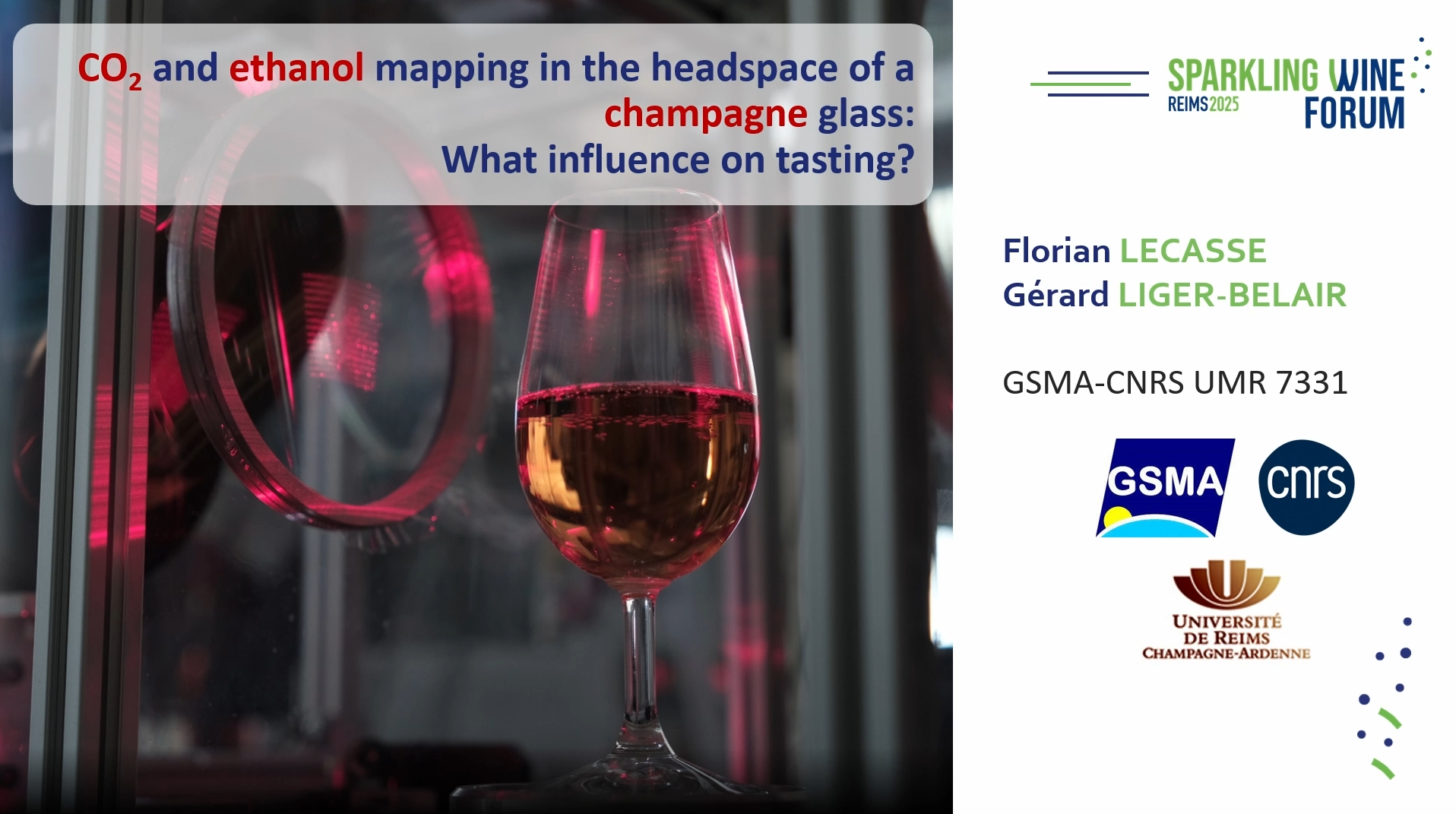
[SWF25] Mapping CO2 and ethanol in the headspace of a glass of champagne : what influence does this have on tasting?
Speakers:
Gérard LIGER-BELAIR - Professor - Effervescence, Champagne, and Applications Team | University of Reims Champagne-Ardenne
Florian LECASSE - Senior Lecturer | University of Reims Champagne-Ardenne
When tasting an effervescent wine, the bursting of the bubbles and the convection movements of the wine induced by the effervescence gradually release gaseous compounds into the head space of the glass, thus modifying the chemical composition of the gas inhaled by the taster. This gas, a mixture of air, fermentative CO 2 and volatile organic compounds (VOCs), gives the wine its bouquet. This bouquet is constantly evolving as the wine is tasted, which suggests that the relative proportions of the various gaseous species that make up the bouquet are constantly changing over time. What is the spatial and temporal evolution of the gaseous species present in the head space of a glass? What is the role of pouring method, serving temperature and the influence of shaking and the shape of the glass on the perception of aromas and flavours?
For some fifteen years now, dedicated tools using laser spectroscopy have been developed in our laboratory to progressively answer all these questions, particularly for gaseous CO 2 and ethanol (two ultra-majority species in the headspace of a glass of sparkling wine).
You must be a member to access this feature
Already member? Log in!

