

Sparkling News is an initiative of EFFEVENT | SAS with a share capital of 140 000 € | RCS of REIMS 878 975 549
Bubbles and patience: when time sculpts great Champagnes
Exclusive interview with Virginie Thollin,
an oenologist specialising in ageing on racks.
There are professions that are practised behind the scenes and passions that are nurtured in the silence of the cellars. Virginie Thollin is one of those who have chosen time as their raw material. An oenologist specialising in ageing on racks, she has dedicated her career to this discreet yet decisive phase in which Champagne truly takes shape — far removed from labels and marketing hype. Balancing intuition with scientific rigour, patience with precision, she shares with us her vision of an often-overlooked art: that of allowing time to shape the bubbles.
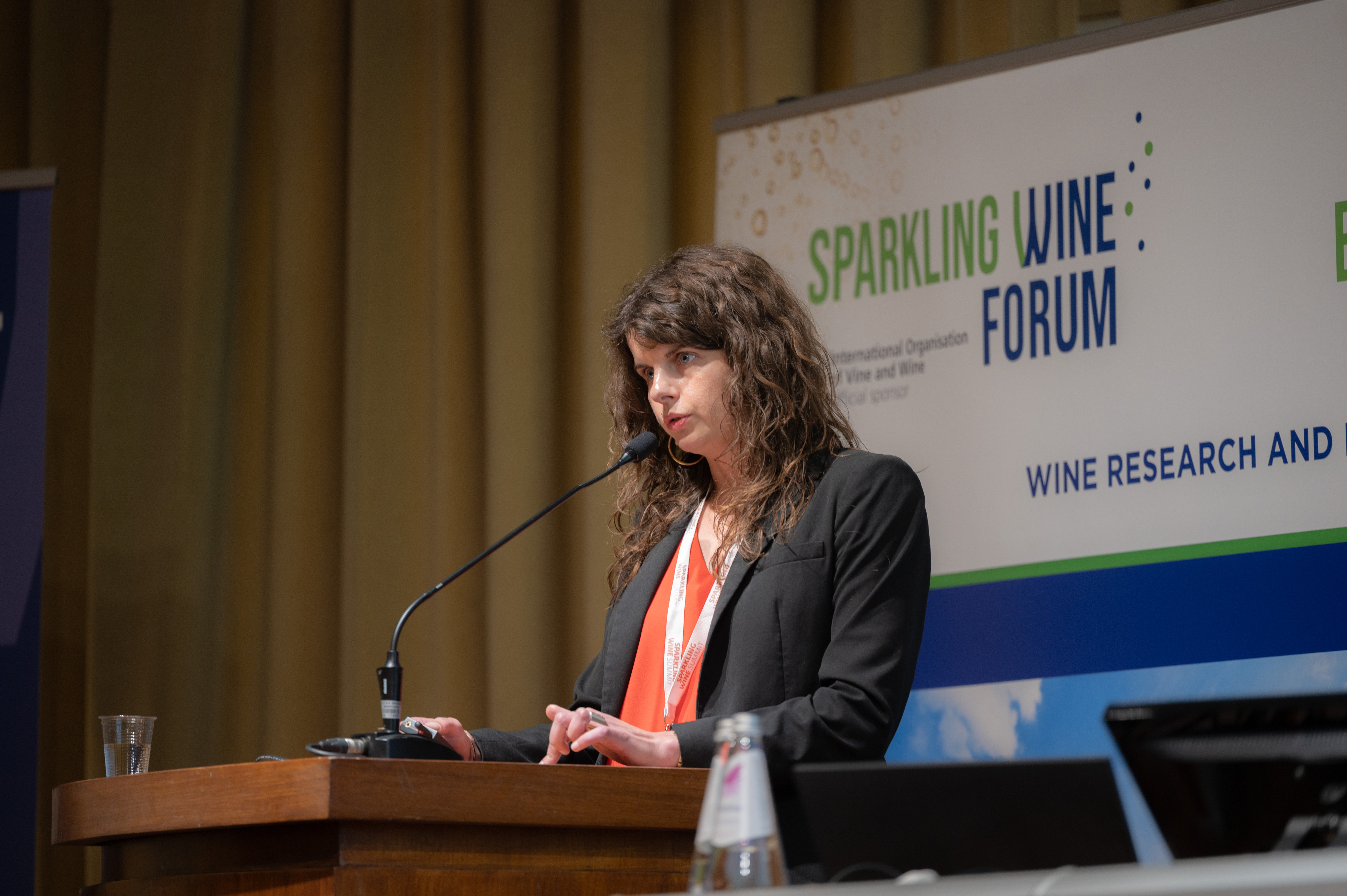
In the world of sparkling wines, some people work behind the scenes, far from the spotlight. Virginie Thollin is one of them. A qualified oenologist from Reims since 2014, she has made ageing on racks her area of expertise — that mysterious phase where time shapes the character of a Champagne, within the cool walls of a cellar. A craft often reduced to regulatory requirements — a minimum of 12 months for a non-vintage Brut, three years for a vintage — yet it is precisely here that everything comes into play. We meet a passionate expert who has dedicated her career to revealing what time does to the bubbles.
A calling born amidst the bubbles
Originally from Lyon, Virginie Thollin discovered wine in her early twenties — a belated revelation that led her to resume her studies in Reims and begin her love affair with sparkling wines. Upon obtaining her DNO qualification, she focused her career exclusively on this type of wine: Crémants de Bourgogne, Clairette de Die made using the ancestral method, then a return to Champagne to work in a variety of organisations, including Champagne Jacquinot and the R&D department at Moët & Chandon.
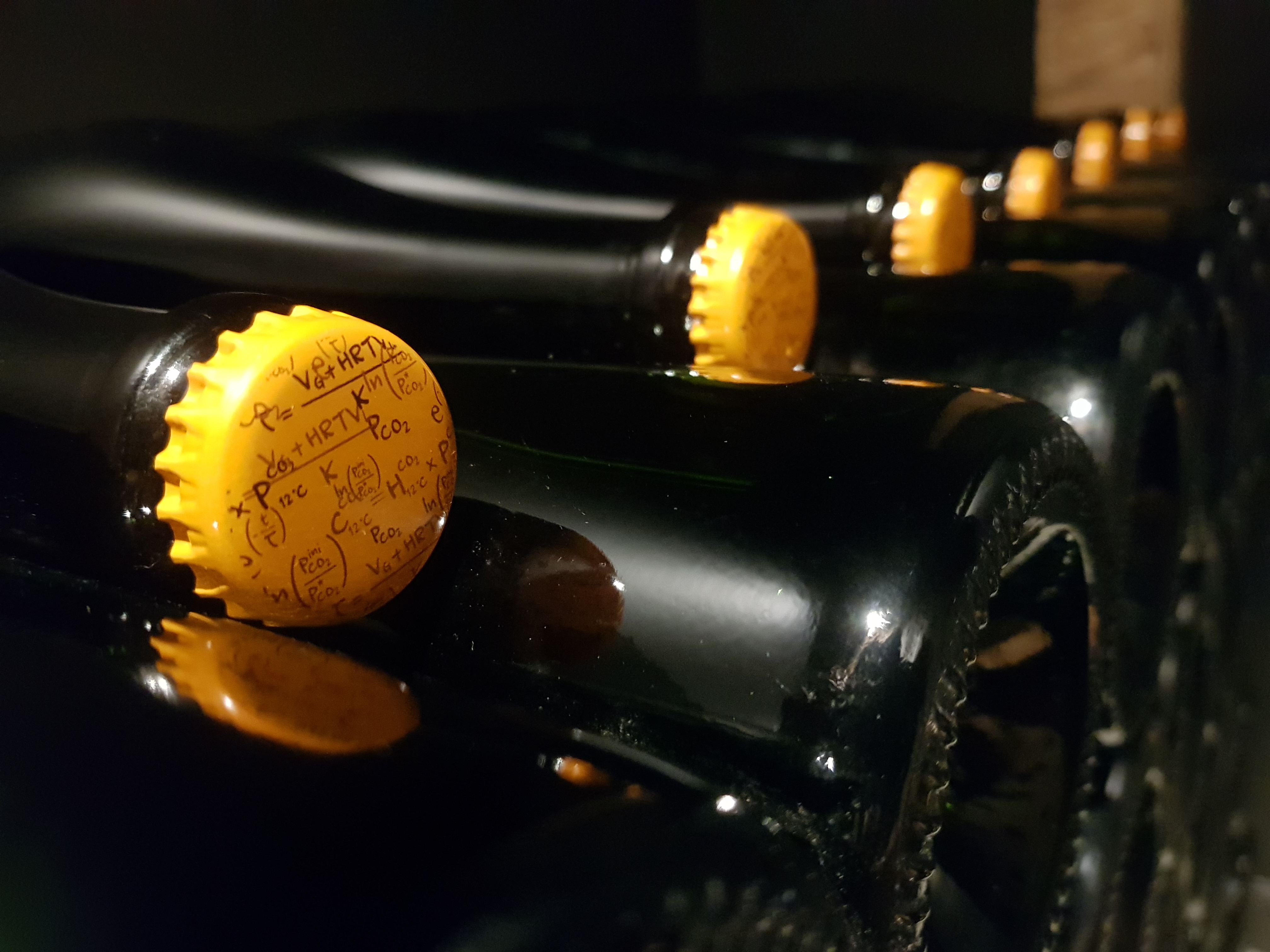
In 2017, she took a significant step forward and joined PE.DI, a company specialising in bottle closures. These metal caps, which look similar to those used on beer bottles, play a crucial role in the development of a wine’s aroma and flavour. She worked there until 2022 and continues this collaboration today as a consultant, working with Gérard Liger-Belair, amongst others. Her expertise lies in the period when bottles age in the cellar after blending. This process can be compared to the maturing of cheese: blending provides the ingredients, but it is time and conditions that reveal the wine’s character.
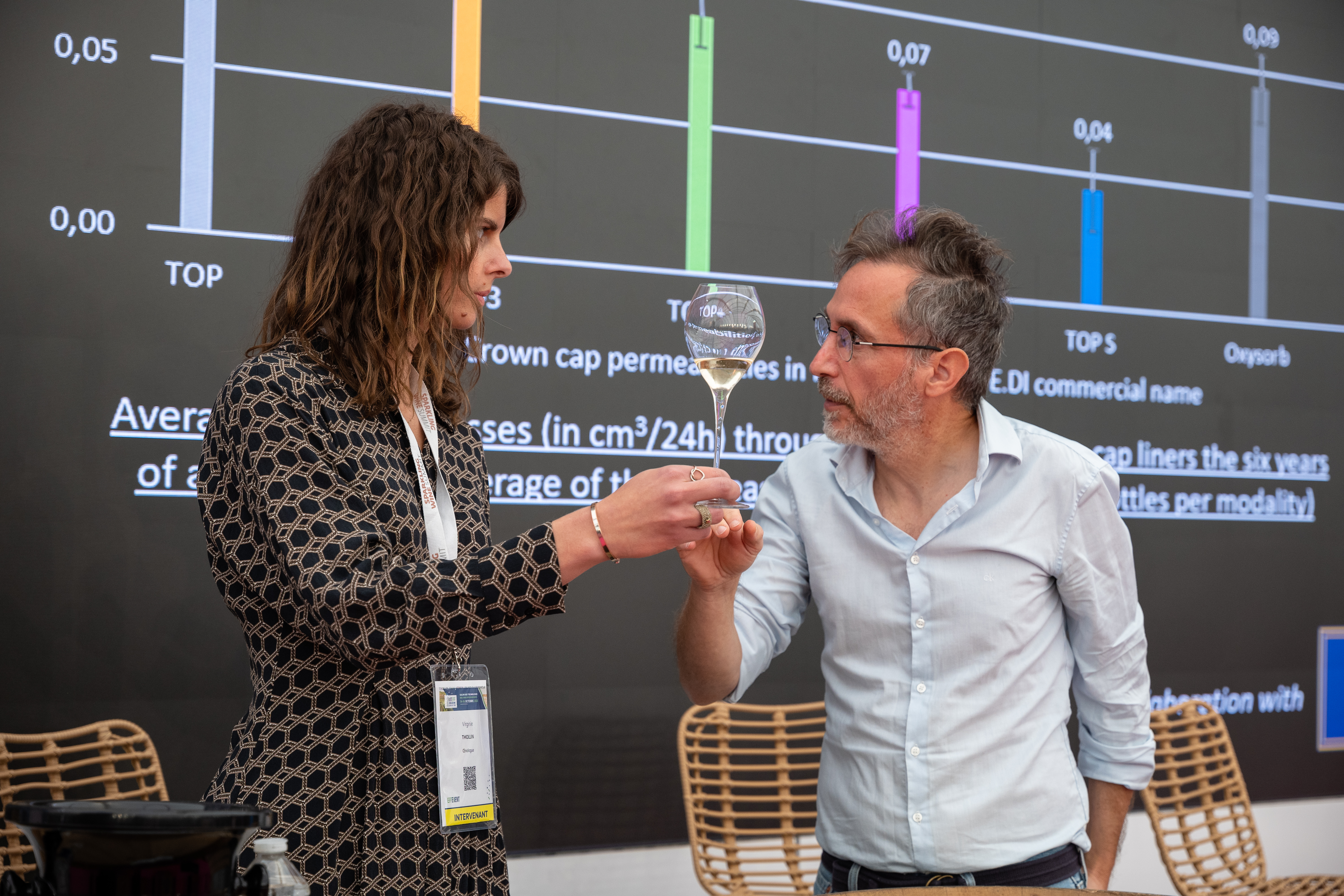
Virginie Thollin with Gérard Liger-Belair at the VITeff 2025 exhibition
Aromas, texture and bubbles: the three pillars of ageing
In sparkling wines produced using the traditional method, tertiary aromas play a major role. Unlike the primary aromas of the grape variety or the secondary aromas resulting from fermentation, they arise, amongst other things, from prolonged contact with the lees, which gradually release aromatic compounds through autolysis. This process takes several months, or even years. The closure also plays a part, allowing a controlled amount of oxygen to enter; far from being harmful, this helps to give the wine its structure.
But ageing on the lees does more than just shape the aromas. Before it begins to develop its effervescence, a Champagne wine often appears particularly lively and austere. Over time, the wine gains roundness and harmony. Gas exchange plays a crucial role: oxygen penetrates slowly, and some of the CO₂ gradually escapes. The level of CO₂ directly influences the bubbles: a high concentration produces a coarser effervescence, whilst a moderate concentration results in fine, creamy bubbles. Thus, the longer the ageing period, the more elegant and silky the bubbles become.
Each vintage has its own ageing process
Each cuvée is unique, and each vintage brings its own distinctive characteristics. The duration of ageing on slats cannot be standardised. It all depends on what one wishes to achieve. To use a culinary metaphor, a chocolate cake can turn out either melt-in-the-mouth or moist, depending on how it is baked, even though the recipe remains the same. The same applies to ageing on slats.
For a young, fresh and fruity wine, the ageing periods are shorter. For fuller-bodied, structured and rounded champagnes, prolonged contact with the lees is necessary. However, a given base cannot undergo every transformation: just as a chocolate cake will never turn into an apple tart, ageing works with the raw material at hand, complementing it, refining it and revealing its potential, without ever betraying it.
Intuition and technique: a necessary dialogue
What is known as ‘oenological intuition’ stems above all from accumulated experience. It enables one to understand the vintage, anticipate how the wines will develop, and guide decision-making. Technical precision then complements this understanding: intuition and technique feed off one another. Intuition points the way; technique confirms, refines or challenges.
Technological advances provide a framework for verifying whether the anticipated direction is consistent with objective data. But the true arbiter remains the tasting, the mechanisms of which are not yet fully understood. Relying solely on intuition would be risky, just as limiting oneself to technique alone would result in wines devoid of soul. The balance lies at the intersection of intuition and rationality, just as it does in life.
A secret little known to the general public
The production of Champagne remains a ‘black box’ for the general public. Many people still imagine that the bubbles are added to the wine in the same way as for a fizzy drink. Even amongst knowledgeable connoisseurs, there is still a lack of understanding of the impact of ageing on the wine. Yet this ageing process gives the wine an extra dimension and largely explains its price point. Storing bottles in a cellar for ten or fifteen years represents a significant tie-up of capital.
Virginie Thollin often notes that when she introduces people who are unfamiliar with champagne to a bottle that has been aged for a certain period, the reaction is frequently: ‘Actually, I quite like champagne’. An aged wine gains in roundness and aromatic complexity, moving away from greener or more aggressive profiles.
When emotion meets technique
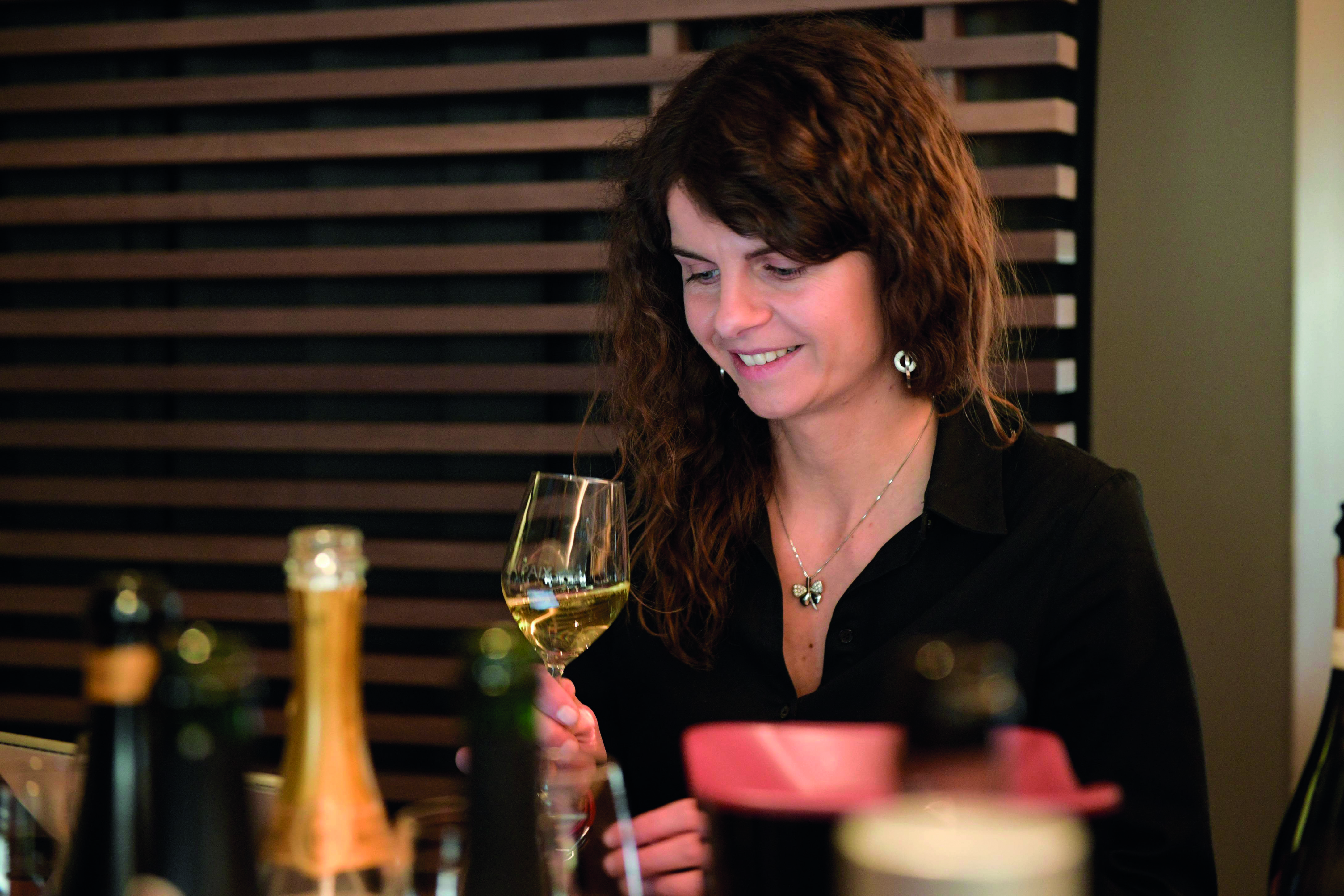
“What moves me deeply is this aromatic richness that becomes almost emotional,” says Virginie Thollin. Certain champagnes have literally brought her to tears — all of them had in common a long, perfectly controlled ageing period on slats, rarely less than ten years. These wines offer a profusion of aromas, such as delicate roasted notes, hints of almond and, at times, coffee, whilst retaining the typical freshness of the Champagne terroir.
“It is a veritable flood of sensory information, almost an explosion of flavours. Just like in the film *Ratatouille*, where flavour combinations create a fireworks display, here there is no longer even any need for such combinations: the aromas follow one another, layer upon one another, and constantly engage the mind. ” According to her, this aromatic complexity can only be achieved in sparkling wines through long ageing on the lees. There is no other way to attain such depth.
Photos courtesy of Rémy Wafflart.
Between patience and timing: the art of bringing out the best in each vintage
In reality, this is primarily down to the winemakers. There is sometimes a gap between the idyllic image of ritual tastings every six months and the reality on the ground. Economic considerations impose their own constraints: certain vintages must be made available to meet demand, even if the wine has not yet reached its full potential. Conversely, some bottles remain in the cellar longer than expected due to a lack of immediate outlets.
Objectively speaking, winemakers generally know when a wine is ready. Whenever possible, they aim to release it at the optimal time. This is where experience and technical expertise come together.
Ageing on slats: a unique asset to be promoted
Champagne benefits from a terroir that provides an exceptional foundation: high acidity, marked structure and great length on the palate. These foundations enable the production of wines with ageing potential capable of maturing for several decades.
Champagne’s true strength, which remains largely untapped elsewhere, lies in ageing on slats. A 2012 Champagne is a fine example of this potential, whilst it is difficult to name a Crémant from the same vintage that has achieved such maturity. Whilst other regions produce sparkling wines — Crémants, Franciacorta, South African or Californian wines — few make use of extended ageing on racks, which brings depth and complexity.
It is essential to make the most of this opportunity. The quality of the base wines is such that it would be a shame not to capitalise on them fully. Champagne has every reason to play this card: to tell the story of time, history and experience. When the aromatic richness reaches this level, the wine evokes emotion, offering a wonderful canvas for storytelling where every winemaker can convey their own story.
